
Global buyers entering the 2026 market need more than a simple product list. Magnesium Oxide Ceramic appears in crucibles, kiln furniture, thermocouple protection tubes, electrical insulation, and high-temperature furnace parts. Each application demands a different balance of purity, density, thermal shock resistance, and machinability.
The USGS Mineral Commodity Summaries 2025 places magnesium compounds within a globally important minerals supply chain. Market research from Grand View Research and MarketsandMarkets also identifies advanced ceramics as a growing industrial materials segment. However, many reports group magnesia with wider ceramic categories. That limitation matters. Buyers should verify the original data before making volume forecasts.
Ceramics authority W. David Kingery defined ceramics as “inorganic, nonmetallic materials.” His principle remains useful here. Magnesium oxide is not one uniform material. Fused magnesia offers strong chemical stability and high-temperature performance. Sintered magnesia provides dependable structural strength. High-purity grades support demanding electrical and laboratory uses. Porous types improve insulation but may absorb moisture. Transparent or highly dense grades serve specialized optical and thermal applications.
Small differences become visible on the factory floor. A cracked setter can interrupt a firing cycle. A contaminated crucible can ruin an entire batch. Grain size matters. So does surface finish.
This guide compares the top types of Magnesium Oxide Ceramic for international buyers in 2026. It considers purity, density, operating temperature, thermal conductivity, dimensional tolerance, certification, and supplier consistency. Product datasheets often look precise. Real performance can still vary. That is where careful sampling, technical audits, and application testing remain essential.
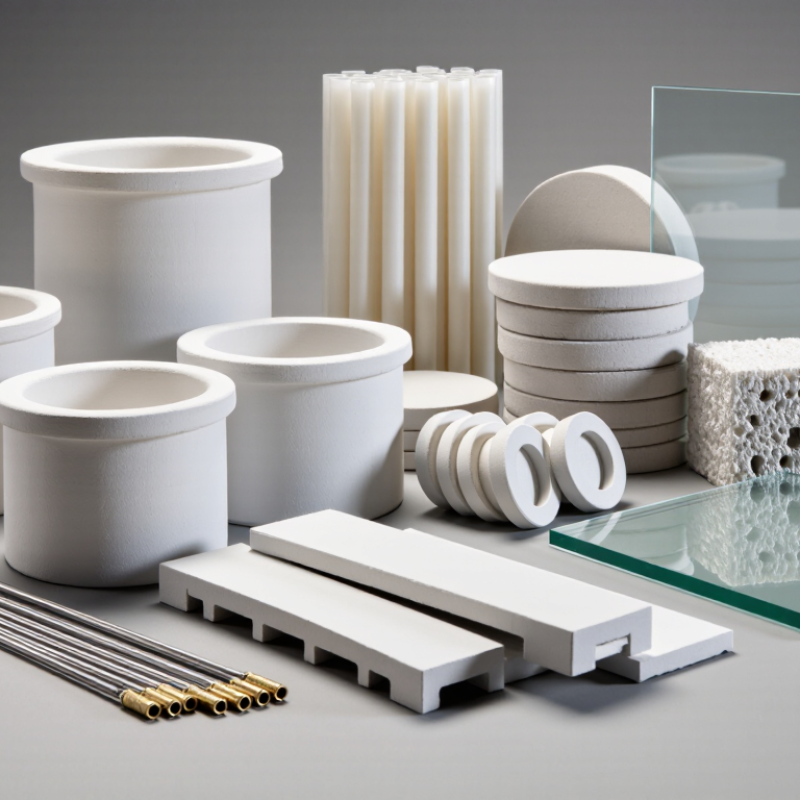
Magnesium oxide ceramic is a refractory material made by firing magnesium oxide powder at high temperatures. Its high melting point, electrical insulation, and resistance to many slags make it valuable in furnaces, thermocouple protection, and high-temperature assemblies. Common forms include sintered MgO, fused MgO, high-purity MgO, and porous MgO. Each type behaves differently under heat.
The 2024 USGS Mineral Commodity Summaries estimated global magnesite mine production at roughly 29 million metric tons in 2023. That supply supports magnesium compounds used across refractories, chemicals, and ceramics. For 2026 buyers, purity and density matter more than a simple “high-temperature” label. High-purity MgO can reduce electrical leakage. Fused grades often offer stronger resistance to thermal shock. Porous grades provide insulation, but they may sacrifice mechanical strength.
Laboratory values are not factory reality.
In practice, moisture control, particle size, firing history, and machining quality can change performance. A 99.5% MgO specification does not guarantee identical service life between suppliers. Buyers should request thermal expansion data, apparent porosity, dielectric strength, batch traceability, and test temperature records. The 2023 International Energy Agency report also highlights the rising importance of industrial efficiency and electrification, increasing demand for reliable insulating components. Yet, energy-intensive ceramic production remains a concern. Magnesium oxide matters in 2026 because it balances heat resistance with electrical and process reliability, although that balance is easy to oversimplify.
It is a refractory ceramic made by firing magnesium oxide powder at high temperatures. It resists intense heat, electrical leakage, and many slags. It is used in furnace parts and insulating assemblies.
Industrial equipment needs dependable insulation and heat resistance. Magnesium oxide ceramic supports electrification, efficient heating, and high-temperature processing. However, production requires significant energy. The balance is not simple.
Common types include dense, porous, fused, high-purity, and stabilized ceramics. Dense grades offer strength and insulation. Porous grades reduce heat transfer and weight. Fused grades often resist thermal shock better.
Dense grades suit crucibles, furnace liners, thermocouple tubes, and heater supports. They perform well near molten materials and corrosive slags. Their smooth white surfaces make cracks easier to inspect. Purity is not enough.
Fine air pockets reduce weight and slow heat transfer. Porous ceramic can suit thermal barriers and kiln furniture. It may handle sudden temperature changes effectively. Excessive porosity lowers strength and increases moisture absorption.
Start with service temperature, thermal cycling, mechanical load, and chemical exposure. Check density, purity, open porosity, strength, and thermal conductivity. For electrical parts, review dielectric strength and volume resistivity. A catalog label can mislead.
Request data from the actual production batch. Useful records include density, purity, tolerances, thermal expansion, and dielectric strength. Also review thermal-shock results, firing temperatures, and traceability. Laboratory values are not factory reality.
Moisture can enter open pores and influence insulation or cracking behavior. Machining before or after firing can change dimensions and final fit. Sharp corners may become weak points during heating. Add a radius when possible.
Yes. Test samples through the actual heating and cooling cycles. Compare dimensional change, corrosion, insulation, and mechanical strength. Assembly stress may cause failure even with excellent material data. Test it hot.
Magnesium Oxide Ceramic is an advanced technical material valued in 2026 for its high-temperature stability, electrical insulation, chemical resistance, and reliable mechanical performance. Global buyers can choose from several forms, including dense sintered ceramics, porous ceramics, crucibles, tubes, boards, and custom-machined components. Each type offers different advantages: dense grades support demanding structural and thermal applications, while porous grades provide insulation and controlled heat transfer. These products are widely used in furnaces, heating systems, laboratory equipment, electrical assemblies, sensors, and high-temperature processing environments.
Selecting the right Magnesium Oxide Ceramic requires evaluating operating temperature, thermal shock, porosity, dimensional accuracy, electrical requirements, chemical exposure, and expected service life. Buyers should also review material composition, purity, density, surface finish, tolerances, test methods, packaging, and traceability. Reliable suppliers should provide clear technical documentation, consistent quality control, sample verification, and production capability for both standard and customized designs. A careful comparison of performance, compatibility, and total cost can help international buyers achieve dependable results and reduce replacement risks.
