Direct factory supply of advanced technical ceramics engineered for severe industrial environments and precision microelectronics.
Comprehensive evaluation of dielectric strength, thermal conductivity, phase stability, and manufacturing metallurgy for industrial applications.
In modern high-voltage electrical engineering, aerospace propulsion, semiconductor fabrication, and heavy industrial processing, the demand for electrical insulation combined with thermal resistance and mechanical integrity has reached unprecedented levels. As a global leading wholesale alumina ceramic insulator manufacturer, our technical research focuses on advancing the boundaries of aluminum oxide ($\text{Al}_2\text{O}_3$) polycrystalline structures to serve critical infrastructures worldwide.
Alumina ceramic insulators owe their remarkable dielectric characteristics to the ionic-covalent bond configuration of the corundum ($\alpha\text{-Al}_2\text{O}_3$) phase. High-purity alumina (ranging from 95% to 99.9% purity) provides an exceptional barrier against electrical conduction under extreme potential gradients. The removal of silica ($\text{SiO}_2$) and alkali metal impurities ($\text{Na}_2\text{O}, \text{K}_2\text{O}$) from the grain boundaries drastically decreases dielectric loss ($\tan \delta$) and mitigates thermal breakdown mechanisms at elevated temperatures.
When specified for high-frequency or high-voltage applications, such as power grid switchgears, x-ray tubes, and plasma chambers, grain boundary microstructures must be tightly controlled via micro-alloying additives (such as $\text{MgO}$ as a grain growth inhibitor) and precision sintering profiles. This yields a dense structure exceeding 99% of theoretical density ($3.98 \text{ g/cm}^3$), neutralizing micro-porosity where electrical arcing and partial discharges originate.
The transition from raw aluminum hydroxide to a finished high-precision insulator involves a multi-stage technical roadmap ensuring dimensional fidelity and zero defect probability:
Sub-micron alumina powders are slurred with organic binders and atomized in spray drying towers to form free-flowing, spherical granules with uniform particle size distribution for optimized compaction density.
To eliminate green-body density gradients typical of uniaxial pressing, complex insulator geometries undergo Cold Isostatic Pressing under hydrostatic pressure up to 200 MPa, delivering isotropic shrinkage during firing.
Sintering is conducted in atmosphere-controlled gas kilns or continuous tunnel kilns. Solid-state diffusion consolidates the ceramic lattice, achieving tight grain structure and high mechanical toughness.
Post-sintering dimensions are finished using high-speed CNC diamond grinding machinery. Surface roughness can be polished down to Ra < 0.1 µm, satisfying stringent vacuum seal tolerances.
For ceramic-to-metal assemblies, refractory metallization (Molybdenum-Manganese process) or Active Metal Brazing (AMB) is applied, enabling robust hermetic joining with Kovar, Stainless Steel, or Copper components.
Every batch undergoes non-destructive evaluation (NDE), ultrasonic flaw detection, helium leak testing ($\text{Leak Rate} < 10^{-11} \text{ mbar}\cdot\text{L/s}$), and high-voltage dielectric breakdown validation.
Vertical Integration from Raw Powder Processing to Precision Ceramic Machining.
Founded in 2003, Yixing Qiangguang Ceramic Materials Co., Ltd. is a professional provider dedicated to the research and development (R&D), manufacturing, and application solutions of high-performance advanced ceramic materials. It is among the few enterprises in China that possess a complete industrial chain, covering key links from powder forming, sintering and precision machining to the provision of integrated application solutions.
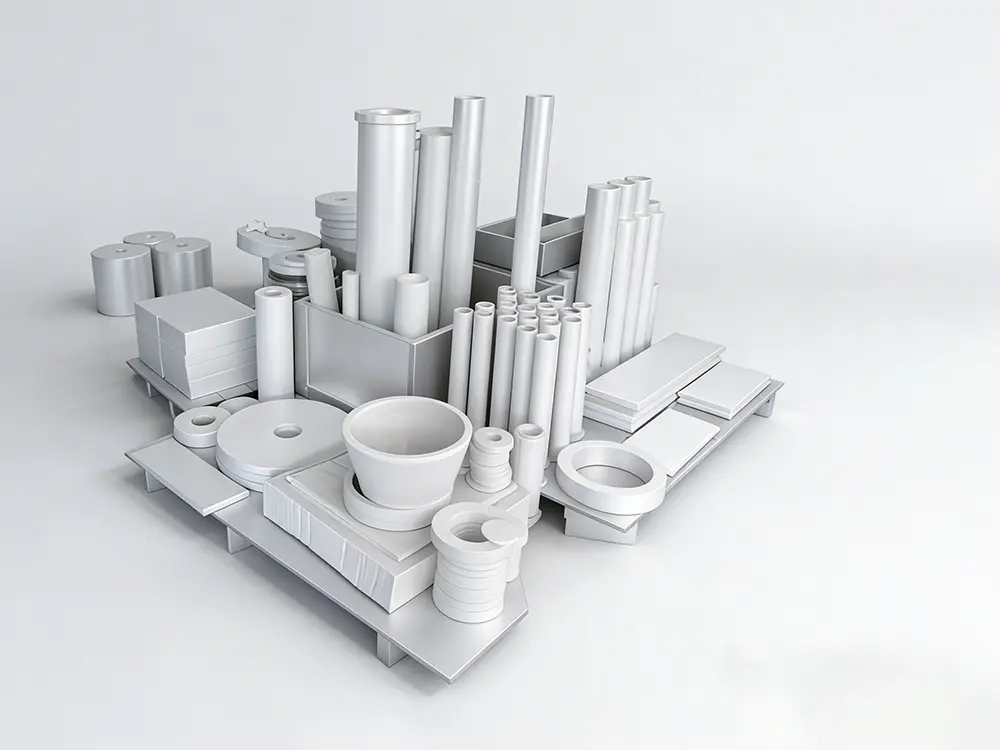
The company is also a rare domestic manufacturer engaged in the R&D, production, and supply of a comprehensive portfolio of ceramic materials. Its product range covers zirconia, yttria, alumina, magnesia, aluminum nitride, boron nitride, silicon nitride, silicon carbide, aluminum titanate and other key ceramic materials for industrial use.
Benefiting from excellent product performance and stable quality, its products are extensively utilized in various high-end fields, such as food and medical industries, new energy vehicles, laser semiconductors, petrochemical engineering, powder metallurgy, national defense and military, as well as aerospace sectors.
Adhering to the core principle of "creating value for customers", Qiangguang provides customized and cost-efficient advanced ceramic solutions tailored to the specific demands of different customers. It is supported by high-quality after-sales services and a strict full-process tracking system, which effectively enhances cooperation efficiency and promotes continuous quality improvement.
At present, the company's products are sold well across the country and exported to Italy, the United Kingdom, Australia, Japan, Malaysia, Thailand, Hungary and other countries and regions. Committed to delivering high-quality products at reasonable prices, Qiangguang sincerely looks forward to establishing long-term and stable cooperative relations with global partners.
Comparative physical, electrical, and thermal properties of industrial alumina ceramics.
| Property Parameter | 95% Al2O3 Insulator | 99% Al2O3 Insulator | 99.5%+ High-Purity Al2O3 | Aluminum Nitride (AlN) |
|---|---|---|---|---|
| Density (g/cm³) | 3.65 | 3.88 | 3.95 | 3.30 |
| Dielectric Strength (kV/mm) | 14 - 16 | 17 - 18 | 19 - 22 | 15 - 18 |
| Thermal Conductivity (W/m·K) | 18 - 21 | 28 - 30 | 32 - 35 | 170 - 230 |
| Dielectric Constant (1 MHz) | 9.0 | 9.6 | 9.8 | 8.9 |
| Flexural Strength (MPa) | 310 | 360 | 400 | 320 |
| Max Working Temp (°C) | 1450 | 1600 | 1700 | 1650 (Inert) |
Custom engineered ceramic components optimized for sector-specific engineering demands.
Alumina insulators provide superior creepage distance, anti-tracking behavior, and weather resistance in outdoor vacuum circuit breakers, disconnect switches, and transformer bushings.
Purity grades up to 99.8% prevent trace metallic contamination in plasma etching, chemical vapor deposition (CVD) chambers, electrostatic chucks (ESC), and high-frequency RF feedthroughs.
Withstanding rapid thermal cycling and extreme voltage spikes, ceramic insulative spacers and metallized seals ensure safe isolation in high-voltage EV battery distribution units and inverter modules.
Lightweight yet structurally robust ceramic igniters, radomes, and sensor housings deliver zero thermal degradation during atmospheric re-entry and high-G force flight conditions.
Non-reactive, biocompatible alumina rings and laser cavity insulators maintain precise optical alignment and withstand continuous sterilization procedures without mechanical degradation.
Extreme chemical inertness to acidic and alkaline environments makes alumina insulators ideal for pyrometer protection tubes, chemical pump seals, and immersion sensor sleeves.
Direct responses to critical procurement, engineering, and manufacturing inquiries.
Explore our full catalog of high-purity ceramic media, stabilizing powders, and structural industrial components.