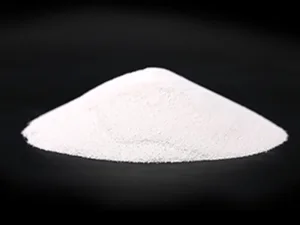
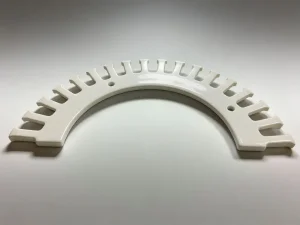
Explore our core industrial product portfolio engineered for extreme thermal, mechanical, and wear environments.
A technical synthesis of lightweight high-density metal-matrix composites engineered to bridge thermal-expansion mismatches in modern microelectronics.
Aluminum Silicon Carbide (AlSiC) represents a revolutionary class of advanced Metal Matrix Composites (MMC) engineered specifically to solve critical thermal stress and weight management bottlenecks in next-generation high-power microelectronics, aerospace avionics, and optical hardware. By pressure-infiltrating molten aluminum alloys into porous, high-density silicon carbide (SiC) preforms, AlSiC seamlessly combines the exceptional hardness, low coefficient of thermal expansion (CTE), and structural rigidity of SiC ceramics with the high thermal conductivity, ductility, and lightweight density of pure aluminum metal.
In high-power electronic devices—such as Insulated Gate Bipolar Transistors (IGBTs) utilized in electric vehicle (EV) traction inverters, high-speed rail, and wind power converters—thermal expansion mismatch between traditional heavy copper baseplates (~17.5 × 10⁻⁶/K) and silicon/silicon carbide semiconductor substrates (~3.0 to 4.0 × 10⁻⁶/K) inevitably leads to catastrophic solder layer fatigue, micro-cracking, and module destruction under cyclic thermal loads. AlSiC directly eliminates this failure mode by offering a fully tunable CTE (typically engineered between 6.5 and 11.5 × 10⁻⁶/K) that matches semiconductor substrates like GaAs, SiC, GaN, and Alumina ceramics, while providing high thermal conductivity up to 220 W/m·K and reducing overall component weight by over 65% compared to copper.
Unlike pure metals or monolithic ceramics, AlSiC's physical characteristics can be tailored at the microstructural level by adjusting the volume fraction of SiC reinforcement particles (ranging from 50% to 75% SiC by volume). This allows mechanical engineers to precisely match the thermal expansion of substrate ceramics (such as AlN and Al2O3) while keeping structural mass below 3.0 g/cm³.
| Material System | Density (g/cm³) | Thermal Conductivity (W/m·K) | CTE (× 10^-6 / K, 25-100°C) | Flexural Strength (MPa) | Young's Modulus (GPa) |
|---|---|---|---|---|---|
| AlSiC (63% SiC Vol) | 3.01 | 180 - 210 | 7.2 - 8.5 | 380 - 450 | 190 - 220 |
| Pure Copper (C11000) | 8.96 | 390 - 400 | 16.8 - 17.5 | 220 - 250 | 110 - 130 |
| Aluminum Alloy (6061) | 2.70 | 160 - 180 | 23.0 - 24.0 | 290 - 310 | 69 - 72 |
| Aluminum Nitride (AlN) | 3.26 | 170 - 200 | 4.5 - 4.8 | 320 - 350 | 310 - 330 |
| Alumina (96% Al2O3) | 3.75 | 24 - 30 | 6.8 - 7.2 | 330 - 380 | 300 - 340 |
| Copper-Tungsten (CuW80) | 15.20 | 180 - 200 | 8.3 - 9.0 | 600 - 680 | 260 - 280 |
| Kovar (Fe-Ni-Co) | 8.36 | 17 - 19 | 5.1 - 5.5 | 520 - 600 | 138 - 145 |
How global tier-1 OEMs and advanced technology manufacturers deploy AlSiC components across mission-critical systems.
Electric vehicle powertrain converters demand relentless thermal cycling stability under continuous vibration and rapid power shifts. AlSiC IGBT baseplates eliminate thermal fatigue delamination between direct-bonded copper (DBC) ceramic substrates and cooling structures, extending module lifetime by up to 10-fold under harsh automotive conditions.
Mass reduction is directly tied to fuel efficiency and payload capacity in space applications. AlSiC replaces dense heavy alloys (like CuW and Kovar) for microwave hermetic packages, T/R radar modules, and satellite heat dissipation plates, cutting structural weight by over 60% while ensuring strict hermeticity sealed via Ni/Au plating.
Modern sub-3nm chip fabrication equipment requires nanometer-level dimensional stability under extreme mechanical acceleration and ambient temperature variations. AlSiC structural frames, wafer stage chucks, and end-effectors combine ultra-high stiffness (Young's modulus ~200 GPa) with near-zero CTE mismatch to prevent optical distortion.
High-power laser diode submounts and optoelectronic enclosures mandate micro-flat surfaces (<2 μm) combined with high localized heat spreading. AlSiC heat sinks prevent thermal lens distortion in industrial fiber lasers, laser surgery apparatus, and high-density optical transceivers.
Traction converters on bullet trains undergo continuous high-voltage power switching and thermal spikes. AlSiC baseplates ensure maximum electrical isolation safety, long-term anti-vibration resistance, and uninterrupted heat transmission directly into liquid cooling manifolds.
Active Electronically Scanned Array (AESA) radar systems require thousands of compact transceiver modules operating at elevated thermal densities. AlSiC hermetic enclosures protect delicate RF circuitry against environmental degradation while maintaining low weight on airborne platforms.
Founded in 2003, Yixing Qiangguang Ceramic Materials Co., Ltd. stands as a premier specialized provider dedicated to the research, development, custom engineering, and mass production of high-performance technical ceramics and advanced composite materials. As one of the rare domestic Chinese manufacturers possessing a fully integrated industrial ecosystem, Qiangguang executes all production phases in-house—ranging from raw powder synthesis and green body forming to vacuum liquid metal infiltration, micro-precision CNC machining, and surface metallization.
Our complete control over the value chain enables global enterprise buyers to achieve unparalleled cost efficiency, rapid prototyping lead-times (2 to 3 weeks), and strict quality compliance under ISO9001 and IATF16949 international standards.
Comprehensive Material Portfolio: Beyond Aluminum Silicon Carbide (AlSiC), Qiangguang manufactures a full suite of industrial ceramics including Zirconia (YSZ, Mg-SZ, Ce-SZ, Ca-SZ), Yttria, Alumina, Magnesia, Aluminum Nitride (AlN), Boron Nitride (BN), Silicon Nitride (Si3N4), Silicon Carbide (SiC), and Aluminum Titanate.
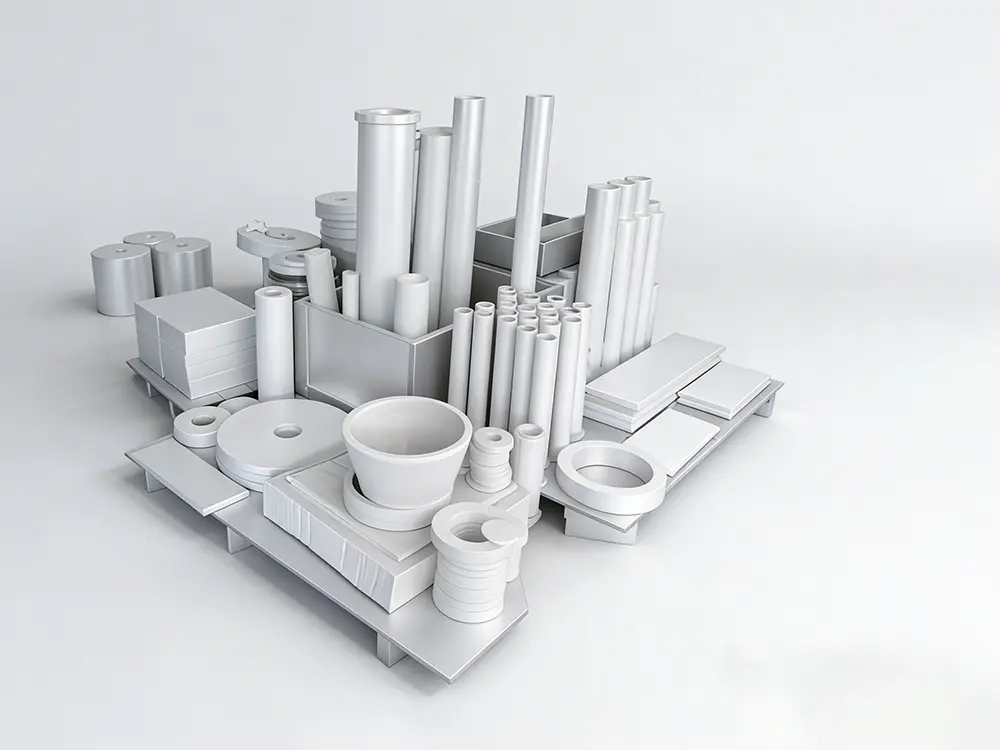
The core manufacturing strength of Qiangguang's AlSiC factory lies in our proprietary Vacuum Pressureless Liquid Metal Infiltration (LMI) and Gas Pressure Infiltration (GPI) technology. This near-net-shape process allows complex geometries—such as integrated cooling fins, internal liquid channels, mounting counterbores, and threaded steel inserts—to be molded directly during preform fabrication, minimizing expensive diamond grinding operations.
Rigorous verification procedures ensuring zero-defect delivery for mission-critical industrial contracts.
Every production lot undergoes dilatometer thermal expansion profiling across the range of -55°C to +150°C to guarantee exact CTE matching with customer-specified ceramic substrates (DBC/DBA) and semiconductor chips.
Non-destructive C-Mode Scanning Acoustic Microscopy (C-SAM) is employed to scan 100% of AlSiC baseplate bodies and solder joints, ensuring absolute zero internal voiding or delamination between aluminum matrix and SiC grains.
For aerospace hermetic packaging applications, components undergo helium mass spectrometer leak detection to confirm hermetic seal ratings tighter than 1 × 10⁻⁹ atm·cc/s He.
Baseplates undergo severe thermal shock testing over 1,000 cycles from -65°C to +150°C. Zero mechanical deformation, micro-cracking, or thermal performance degradation is strictly enforced.
Plated Ni/Au coatings are subjected to thermal bake tests and tape pull-off testing (ASTM D3359) to confirm superior adhesion strength preventing plating peel-off during high-temperature die mounting.
Supported by a comprehensive ERP tracking system, Qiangguang provides raw material lot certifications, dimensional inspection reports, and full process parameters for every delivered order.
Anticipating next-decade technological shifts in thermal management and composite materials science.
As semiconductor substrates shift toward Wide Bandgap (WBG) materials like Diamond-on-SiC and Gallium Oxide (Ga2O3), demand for lower CTE values (below 6.0 × 10⁻⁶/K) is driving the development of ultra-high density SiC preforms with tailored particle bimodal distributions.
To eliminate thermal resistance in EV drive inverters, AlSiC baseplates are increasingly manufactured with integrated 3D pin-fin liquid cooling channels, enabling direct coolant contact and boosting inverter heat dissipation density by 35%.
Additive manufacturing technologies are being integrated into green-body preform shaping, allowing complex internal micro-channel geometries that were previously impossible to achieve via conventional pressing or slip casting.
Expert engineering answers to common technical queries from procurement teams and thermal designers.
Adhering to the core principle of "creating value for customers", Qiangguang provides customized and cost-efficient advanced ceramic solutions tailored to the specific demands of different customers. It is supported by high-quality after-sales services and a strict full-process tracking system, which effectively enhances cooperation efficiency and promotes continuous quality improvement.
At present, the company's products are sold well across the country and exported to Italy, the United Kingdom, Australia, Japan, Malaysia, Thailand, Hungary and other countries and regions. Committed to delivering high-quality products at reasonable prices, Qiangguang sincerely looks forward to establishing long-term and stable cooperative relations with global partners.
Discover our specialized advanced materials for thermal shock resistance, wear parts, and ultra-high temperature applications.