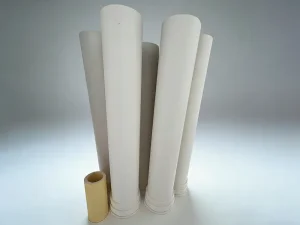
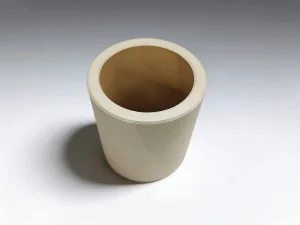
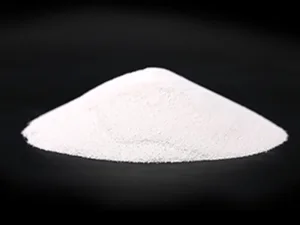
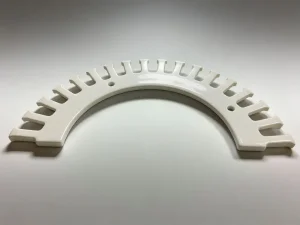
In modern metallurgical engineering and ultra-high-temperature manufacturing, China ceramic casting factories have evolved from traditional component suppliers into indispensable technological partners. High-performance advanced ceramic materials—including Yttria-Stabilized Zirconia (YSZ), Aluminum Nitride (AlN), Aluminium Titanate ($\text{Al}_2\text{TiO}_5$), Magnesium Oxide ($\text{MgO}$), and Silicon Nitride ($\text{Si}_3\text{N}_4$)—represent the backbone of next-generation industrial casting, thermal management, and precision mechanical operations.
As global industrial demand shifts toward zero-defect, extreme thermal shock resistance, and micro-tolerance capabilities, investment casting foundries across North America, Europe, and the Asia-Pacific region are increasingly relying on specialized Chinese ceramic manufacturers. The convergence of advanced powder synthesis, cold isostatic pressing (CIP), sinter-HIP technology, and automated CNC green-state machining has placed Chinese factories at the forefront of the global structural ceramic market.
Advanced ceramic formulation designed to withstand operating temperatures exceeding 1750°C without chemical decomposition or volumetric degradation.
High-dimensional stability ceramic casting cores designed for hollow turbine blades, intricate valves, and micro-fluidic channels.
Exceptional resistance against molten superalloys, reactive titanium melts, aggressive acids, and corrosive industrial slurries.
Founded in 2003, Yixing Qiangguang Ceramic Materials Co., Ltd. is a professional provider dedicated to the research and development (R&D), manufacturing, and application solutions of high-performance advanced ceramic materials. It stands among the premier enterprises in China possessing a completely integrated industrial chain—covering every critical phase from raw powder preparation, cold molding, precision sintering, to ultra-tolerant diamond grinding and final component integration.
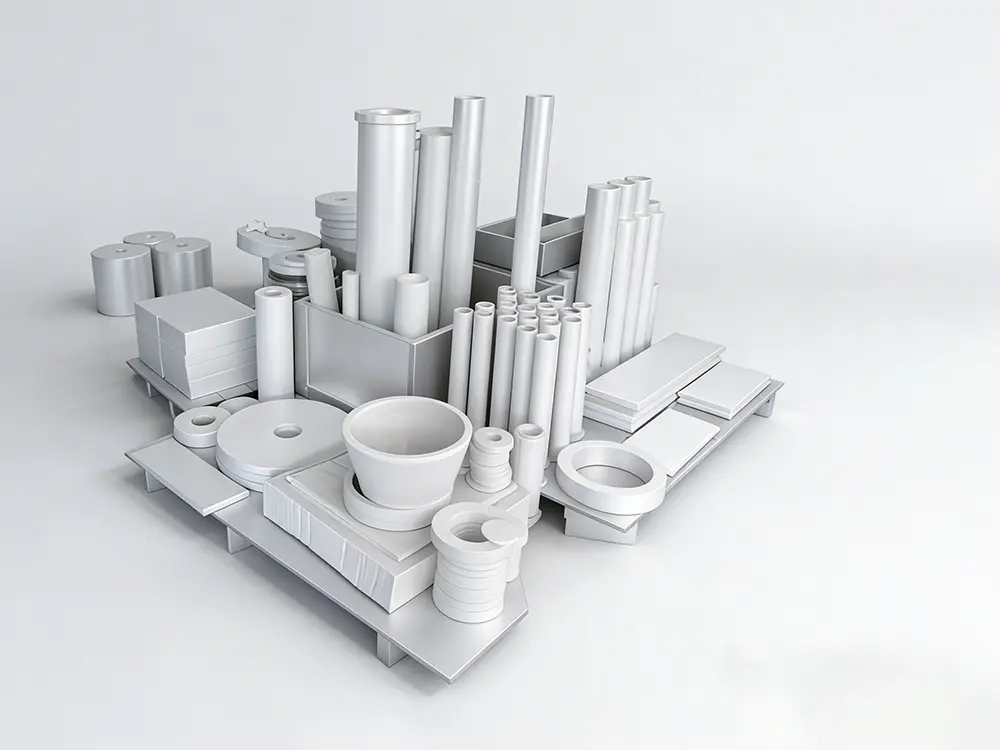
Distinguishing itself as a comprehensive material pioneer, Qiangguang manufactures an expansive portfolio covering structural and functional ceramics. The product spectrum incorporates high-purity zirconia ($\text{ZrO}_2$), yttria ($\text{Y}_2\text{O}_3$), alumina ($\text{Al}_2\text{O}_3$), magnesia ($\text{MgO}$), aluminum nitride ($\text{AlN}$), boron nitride ($\text{BN}$), silicon nitride ($\text{Si}_3\text{N}_4$), silicon carbide ($\text{SiC}$), aluminum titanate ($\text{Al}_2\text{TiO}_5$), and specialized composite ceramic powders.
Benefiting from superior physical properties, thermal stability, and rigorous quality control systems, Qiangguang's technical ceramic solutions are deployed extensively across high-tech domains globally: semiconductor laser equipment, food and pharmaceutical processing, medical implants, new energy vehicle (NEV) power modules, petrochemical machinery, powder metallurgy, aerospace systems, and national defense applications.
Adhering to the core value of "Creating Value for Customers," Qiangguang delivers tailored, cost-effective ceramic engineering solutions backed by stringent full-process quality tracking and dedicated technical support.
With established market leadership across China, products are exported to Italy, the United Kingdom, Australia, Japan, Malaysia, Thailand, Hungary, and over 40 other nations, fostering enduring industrial alliances.
The ceramic casting sector is undergoing unprecedented technological convergence. Fueled by requirements from aerospace turbine manufacturers and semiconductor lithography equipment builders, leading Chinese ceramic factories are pioneering three major macro-trends:
Integrating 3D printing (Stereolithography SLA and Binder Jetting) with traditional ceramic slip casting allows for rapid prototyping of ceramic cores without expensive metal tooling. Sub-micron ceramic slurries enable rapid production of sacrificial investment casting cores for complex cooling channels in single-crystal nickel turbine blades.
Transitioning from micro-grain ceramics to nanostructured Yttria-Stabilized Zirconia (YSZ) and Sub-micron Alumina ($\text{Al}_2\text{O}_3$) significantly boosts flexural strength (>1200 MPa) and fracture toughness. High-purity chemical vapor synthesis eliminates trace metallic impurities, crucial for semiconductor thermal management.
Precision metallurgical casting requires ceramic shells and cores that maintain mechanical rigidity at 1650°C during metal pouring, yet possess tailored chemical leachability (using caustic solutions) after solidification. Modern Chinese factories engineered specialized fused silica-zircon composites to optimize this balance.
Global procurement strategies are heavily focused on risk mitigation, Total Cost of Ownership (TCO), and supply chain continuity. China’s advanced ceramic ecosystem—headquartered in industrial hubs such as Yixing, Jiangsu—presents unique structural advantages that cannot be replicated easily elsewhere:
1. Complete Vertical Upstream-to-Downstream Integration: From synthetic mineral refining (zirconium silicate, bauxite, raw magnesium nitriding) to specialized toolmaking, kiln fabrication, and precision CNC finishing, Chinese clusters operate with minimized lead times. This cluster effect reduces raw material transit delays from weeks to hours.
2. Energy Efficiency & Automation in Sintering: High-temperature sintering (1600°C–1900°C) is an energy-intensive process. Chinese ceramic foundries have implemented continuous atmospheric tunnel kilns, automated robotic pick-and-place systems, and real-time pyrometric optical sensors, yielding lower per-unit energy expenditure and consistent batch-to-batch thermal history.
3. Agility in Rapid Customization & Prototyping: Unlike legacy Western facilities bound by rigid multi-month re-tooling schedules, modern Chinese ceramic factories utilize agile mold fabrication, permitting prototype samples to be delivered in 10 to 14 days.
Selecting the appropriate ceramic material for casting cores, structural wear parts, or thermal management components demands careful analysis of physical properties. The data below outlines key engineering metrics across primary advanced ceramics manufactured by Chinese suppliers:
| Material Type | Density (g/cm³) | Flexural Strength (MPa) | Thermal Conductivity (W/m·K) | Max Operating Temp (°C) | Key Application Focus |
|---|---|---|---|---|---|
| Yttria-Stabilized Zirconia (YSZ) | 6.05 | 1000 - 1200 | 2.5 - 3.0 | 1500 | High-wear valves, structural casting components, oxygen sensors |
| Aluminum Nitride (AlN) | 3.26 | 350 - 400 | 170 - 230 | 1600 (Inert) | Semiconductor thermal substrates, heat sinks, power modules |
| Aluminium Titanate ($\text{Al}_2\text{TiO}_5$) | 3.40 - 3.70 | 40 - 80 | 1.5 - 2.5 | 1400 | Low-pressure casting riser tubes, molten aluminum dosing |
| High-Purity Alumina ($\text{Al}_2\text{O}_3$ 99.7%) | 3.92 | 380 - 450 | 30 - 35 | 1700 | Grinding media, electrical insulators, corrosion rings |
| Magnesium Oxide ($\text{MgO}$) | 3.58 | 200 - 250 | 40 - 60 | 2200 | Ultra-high-temp crucibles, nuclear & metal alloy casting refractories |
In non-ferrous and superalloy foundries (e.g., aerospace blade casting), ceramic cores manufactured from specialized silica-zirconia or alumina formulations define internal cooling circuits. High dimensional repeatability prevents core shifting or thermal breakdown during vacuum casting.
Aluminum Nitride (AlN) and ultra-high purity Alumina ceramics are deployed as wafer chucks, end effectors, and plasma-resistant chamber rings. High electrical resistivity paired with thermal dissipation prevents dielectric breakdown in plasma etch tools.
Silicon Nitride and Zirconia structural elements serve as high-speed ceramic bearing balls, motor shaft insulation, and thermal interface substrates in EV inverter drives, enabling continuous high-voltage operation.
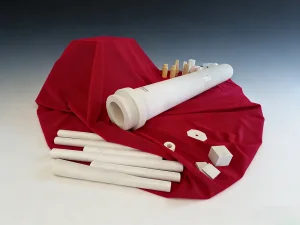
Aluminium Titanate ($\text{Al}_2\text{TiO}_5$) riser tubes and sprue bushings possess non-wetting properties against molten aluminum. This ensures non-stick performance, drastically reducing dross formation and maintenance downtime in low-pressure die casting.