Explore our top-tier engineered ceramic components, precision-molded and sintered for extreme thermal, wear, and dielectric environments.
Integrating full-process advanced technical ceramics engineering—from nano-powder compounding and green body molding to diamond precision grinding.
Founded in 2003, Yixing Qiangguang Ceramic Materials Co., Ltd. stands as a premier enterprise dedicated to the research, development, custom manufacturing, and precision engineering of advanced ceramic materials. Situated at the heart of China's technical ceramic industrial capital, Yixing, the company represents a rare group of global manufacturers possessing a fully integrated end-to-end industrial value chain.
Unlike conventional processors who rely on third-party green bodies or pre-fabricated ceramic blanks, our capabilities cover all core production phases: ultra-fine powder synthesis & slip preparation, high-pressure dry pressing, Cold Isostatic Pressing (CIP), Ceramic Injection Molding (CIM), high-temperature vacuum sintering, and multi-axis CNC diamond machining. This vertically integrated control ensures absolute batch-to-batch consistency, total material traceability, and unprecedented molding precision.
Our expansive ceramic portfolio encompasses structural and functional engineering materials, including Zirconia (ZrO2), Yttria-Stabilized Zirconia (YSZ), Magnesia-Stabilized Zirconia (MSZ), High-Purity Alumina (Al2O3), Silicon Nitride (Si3N4), Aluminum Nitride (AlN), Boron Nitride (BN), Silicon Carbide (SiC), Magnesium Oxide (MgO), and Aluminium Titanate (Al2TiO5).
Delivering dimensional fidelity and structural integrity through tailored powder compaction, injection molding, and sub-micron finishing techniques.
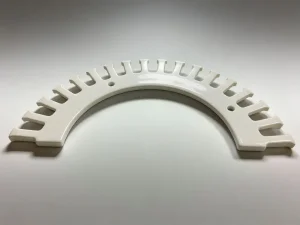
Ideal for complex 3D geometric components with intricate internal channels, threads, and thin walls. CIM combines organic thermoplastic binders with sub-micron ceramic powders. After automated molding, multi-stage solvent and thermal debinding guarantee defect-free sintering with density exceeding 99.5% theoretical limits.
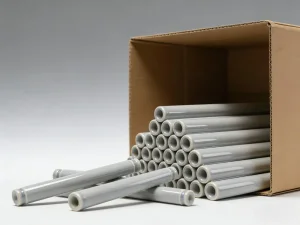
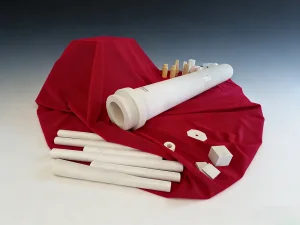
Utilizing hydrostatic fluid pressure up to 300 MPa, CIP yields extremely uniform green body density. This eliminates internal stress gradients, enabling distortion-free sintering of large-scale rods, thick tubes, and structural blanks prior to precision CNC diamond grinding.
Post-sintering ceramics exhibit hardness second only to diamond (Vickers Hardness HV 1200-2000). Our state-of-the-art 5-axis CNC grinding machining centers utilize resin-bonded and metal-bonded diamond tooling to achieve geometrical tolerances of ±0.001mm and surface roughness of Ra < 0.05 µm.
| Molding Technology | Target Geometries | Dimensional Accuracy | Surface Finish (As-Sintered) | Economic Volume Batch |
|---|---|---|---|---|
| Ceramic Injection Molding (CIM) | Complex 3D features, internal threads, micro-geometries | ±0.3% of nominal (Down to ±0.005mm with grinding) | Ra 0.4 - 0.8 µm | High Volume (>5,000 pcs) |
| Cold Isostatic Pressing (CIP) | Large rods, thick-walled pipes, structural billets | ±0.5% (Requires CNC machining for precision) | Ra 1.6 - 3.2 µm | Prototype to Medium Volume |
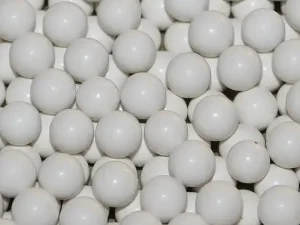
| Dry Uniaxial Pressing | Simple discs, rings, flat substrates, ceramic balls | ±0.2% - ±0.4% | Ra 0.8 - 1.2 µm | Mass Production (>10,000 pcs) |
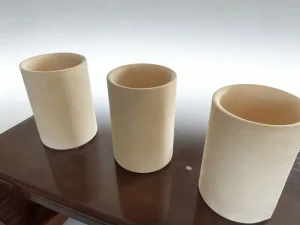
| Slip Casting & Pressure Casting | Hollow vessels, complex tubes, irregular crucibles | ±1.0% - ±1.5% | Ra 1.6 - 2.5 µm | Low to Medium Volume |
Select from our broad array of engineered ceramic formulations customized for high temperature, extreme friction, chemical attack, and electrical isolation.
Featuring supreme fracture toughness ($6.0 - 8.5 \text{ MPa}\cdot\text{m}^{1/2}$) and thermal shock resistance. Widely specified for aerospace bearings, gas turbine components, and non-ferrous molten metal handling valves.
Combines high thermal conductivity ($170 - 230 \text{ W/m}\cdot\text{K}$) with excellent electrical insulation. The premier substrate material for high-power semiconductor modules, laser diodes, and LED thermal management.
Extremely high flexural strength ($>1000 \text{ MPa}$) and wear resistance. Phase transformation toughening prevents crack propagation, making it ideal for medical implants, metering pumps, and industrial blade tools.
The versatile workhorse of engineering ceramics. Delivers outstanding dielectric strength, corrosion resistance, and high temperature stability up to 1700°C for electrical insulators and chemical pump shafts.
Remarkable resistance to thermal shock due to its near-zero coefficient of thermal expansion. Non-wetting by aluminum alloys makes it indispensable for riser tubes and low-pressure die-casting nozzles.
High thermal stability and high-temperature electrical resistivity. Used extensively in thermocouple insulation, heating element cores, and metallurgical crucibles in aggressive chemical environments.
Deploying precision ceramic components into critical mission systems across semiconductor, medical, aerospace, and renewable energy sectors worldwide.
Qiangguang’s engineered ceramic components are trusted by fortune-500 OEMs and tier-1 system integrators across Europe, North America, and the Asia-Pacific region. With active exports to Italy, the United Kingdom, Australia, Japan, Malaysia, Thailand, Hungary, and beyond, our logistics and technical account management networks ensure seamless cross-border supply chain integration.
Adhering to our founding principle of "Creating measurable value for global customers," we provide end-to-end technical consulting. Our ceramic engineers collaborate directly with client design teams during early DFM (Design for Manufacturability) stages to reduce unit manufacturing cost while optimizing mechanical reliability.
Leveraging Yixing's world-renowned ceramic industrial cluster for raw material security, cost leadership, and rapid rapid-prototyping capabilities.
Located in Yixing, Jiangsu—China's historical hub for technical ceramics—our plant gains immediate access to specialized raw material refining, precision tooling fabricators, and gas atmosphere sintering kiln suppliers within a 30-minute radius.
Our agile production lines allow quick-turn sample fabrication. Custom green-state CNC machining enables prototype delivery within 7-10 working days, significantly compressing our clients' R&D cycles.
High-capacity automated pressing lines combined with optimized electric shuttle kilns deliver substantial economies of scale. We pass on 20% to 40% cost savings compared to European or American ceramic suppliers without compromising microstructural quality.
Robust domestic raw material partnerships eliminate vulnerability to geopolitical supply bottlenecks. Strategic reserves of high-purity chemical precursors guarantee stable long-term mass production pricing.
Pioneering additive manufacturing, AI-driven sintering, and nano-composite structural ceramics for next-decade industrial challenges.
Investing in Stereolithography (SLA) and Digital Light Processing (DLP) for advanced ceramics. Enables tool-less fabrication of hyper-complex conformal cooling channels and weight-reduced ceramic structures for aerospace payloads.
Integrating machine learning algorithms into atmosphere sintering kilns. Real-time optical sensors dynamically adjust temperature ramp profiles to eliminate grain growth defects and maximize Weibull strength modulus.
Developing Al2O3-ZrO2 (ZTA) and Si3N4-SiC nano-composites. By embedding nano-phase particles along grain boundaries, we achieve exceptional thermal shock resistance and flexural strength exceeding 1200 MPa.
Rigorous full-process quality tracking and international regulatory adherence guarantee absolute reliability in high-consequence applications.
Our metrology labs are outfitted with Zeiss Coordinate Measuring Machines (CMM), Keyence optical profilometers, ultrasonic flaw detectors, and laser thermal conductivity meters. Every batch undergoes non-destructive testing (NDT), density verification (Archimedes method), and dimensional tolerance validation before dispatch.
All raw materials and finished ceramic articles satisfy strict international environmental and safety protocols, including RoHS, REACH, and FDA biocompatibility guidelines for medical components. Fully documented material test reports (MTR) and certificate of analysis (COA) are included with every delivery.
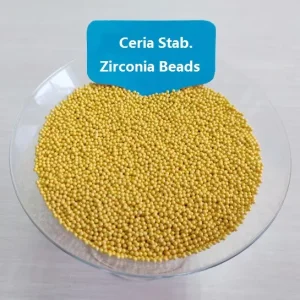
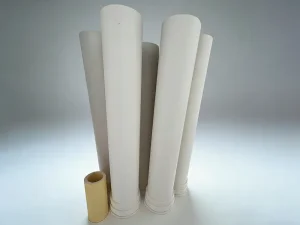
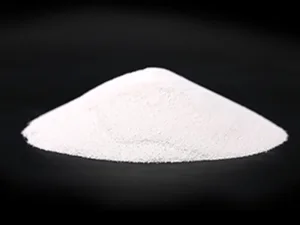
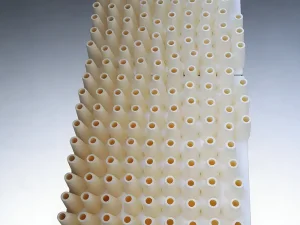
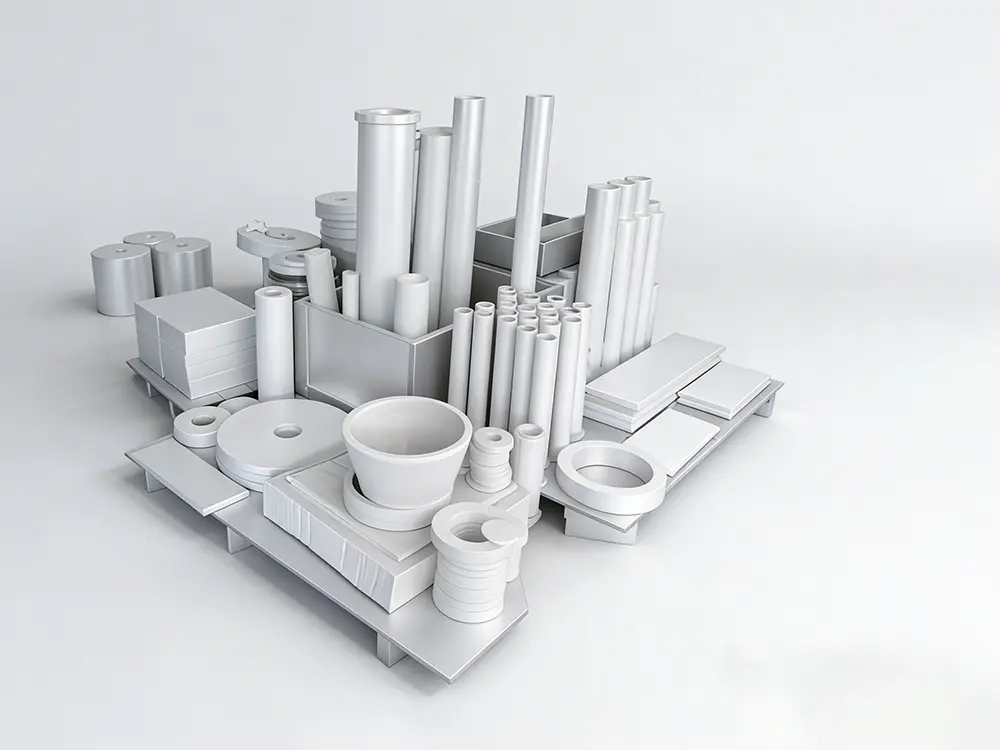
Comprehensive portfolio of engineered ceramic powders, grinding media, and precision technical components ready for global deployment.
Answers to common technical queries regarding precision ceramic molding tolerances, material selection, production lead times, and global shipping.
In as-sintered state (via Ceramic Injection Molding or Dry Pressing), typical linear tolerances range between ±0.2% and ±0.5%. However, using post-sintering diamond CNC grinding, lapping, and honing, we routinely guarantee micro-tolerances down to ±0.001mm (1 micron), with surface roughness Ra < 0.05 µm and cylindrical concentricity within 0.002mm.
Zirconia offers higher flexural strength (>1000 MPa) and superior surface smoothness, making it preferred for medical instruments, shaft seals, and room-temperature wear components. Silicon Nitride (Si3N4), while slightly lower in room-temperature strength, maintains exceptional mechanical properties up to 1200°C and possesses outstanding thermal shock resistance and lower density (3.2 g/cm³ vs 6.0 g/cm³), rendering it superior for high-speed bearings and thermal cycle environments.
For rapid prototypes requiring custom green-state machining, sample dispatch takes approximately 7 to 14 business days. For volume production utilizing custom injection or pressing tooling, mold fabrication takes 15-20 days, followed by mass production runs of 2 to 3 weeks depending on batch volume and finishing requirements.
Yes. Our engineering team conducts thorough DFM evaluations on client 3D STEP/IGES models to identify potential sintering distortion risks, sharp interior radii, or excessive machining walls. We recommend optimal ceramic formulations and minor geometric tweaks to maximize component lifespan while minimizing production cost.