Explore our premium wholesale formulations engineered for electronics, extreme thermal resistance, and precision engineering.
Understanding the transition from traditional kaolinitic clays to engineered high-purity synthetic oxide and nitride ceramic matrices.
In modern industrial procurement, the term "Wholesale Clay Distributors, Manufacturers & Suppliers" has evolved far beyond traditional earthenware, ball clay, and brick-making minerals. Today’s industrial landscape demands precision-engineered clay minerals and synthetic ceramic powders capable of withstanding extreme mechanical stress, high voltage, cryogenic temperatures, and corrosive chemical environments.
Engineered technical clays and structural ceramic formulations—such as Alumina ($Al_2O_3$), Yttria-Stabilized Zirconia ($YSZ$), Magnesium Stabilized Zirconia ($MSZ$), Aluminum Nitride ($AlN$), and Silicon Nitride ($Si_3N_4$)—serve as the architectural bedrock for 21st-century technology. Global B2B buyers, system integrators, and OEM procurement managers require direct factory partnerships with suppliers that offer full vertical integration: from raw mineral refinement to powder spray drying, cold isostatic pressing (CIP), high-temperature sintering, and micro-inch diamond machining.
Demonstrating over two decades of manufacturing excellence, full-chain production control, and global supply compliance.
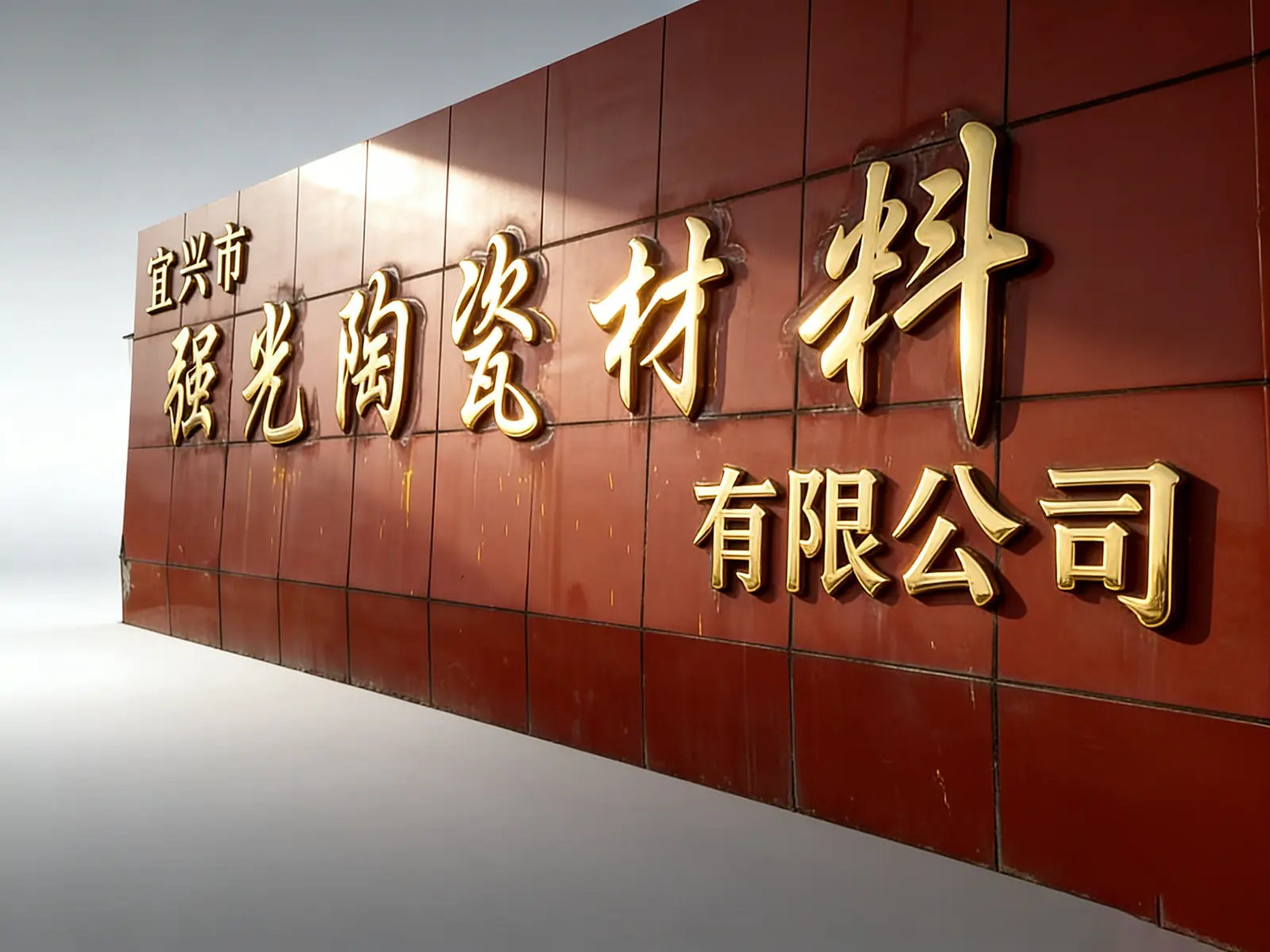
Founded in 2003, Yixing Qiangguang Ceramic Materials Co., Ltd. is a professional provider dedicated to the research and development (R&D), manufacturing, and application solutions of high-performance advanced ceramic materials. It is among the few enterprises in China that possess a complete industrial chain, covering key links from powder forming, sintering, and precision machining to the provision of integrated application solutions.
The company is also a rare domestic manufacturer engaged in the R&D, production, and supply of a comprehensive portfolio of ceramic materials. Its product range covers zirconia, yttria, alumina, magnesia, aluminum nitride, boron nitride, silicon nitride, silicon carbide, aluminum titanate and other key ceramic materials for industrial use.
Benefiting from excellent product performance and stable quality, its products are extensively utilized in various high-end fields, such as food and medical industries, new energy vehicles, laser semiconductors, petrochemical engineering, powder metallurgy, national defense and military, as well as aerospace sectors.
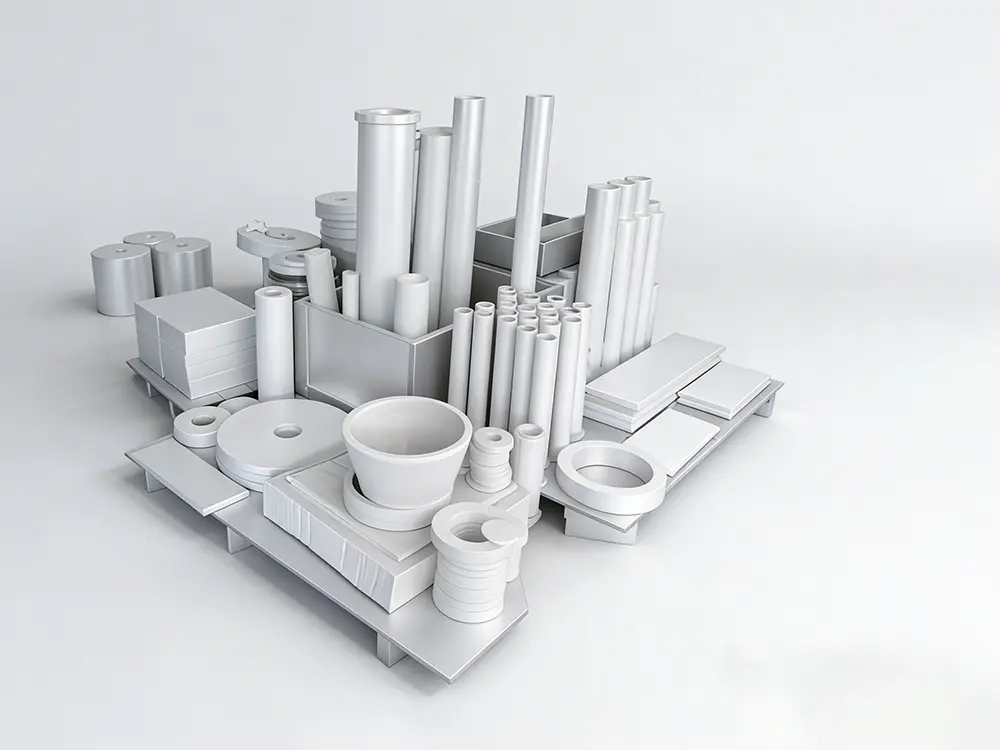
Adhering to the core principle of "creating value for customers", Qiangguang provides customized and cost-efficient advanced ceramic solutions tailored to the specific demands of different customers. It is supported by high-quality after-sales services and a strict full-process tracking system, which effectively enhances cooperation efficiency and promotes continuous quality improvement.
At present, the company's products are sold well across China and exported to Italy, the United Kingdom, Australia, Japan, Malaysia, Thailand, Hungary and other countries and regions. Committed to delivering high-quality products at reasonable prices, Qiangguang sincerely looks forward to establishing long-term and stable cooperative relations with global partners.
Comprehensive comparison of primary physical, thermal, and electrical properties of industrial advanced ceramic compounds.
| Material Matrix | Density ($g/cm^3$) | Flexural Strength ($MPa$) | Thermal Conductivity ($W/m\cdot K$) | Max Service Temp ($^\circ C$) | Primary Industrial Utility |
|---|---|---|---|---|---|
| Alumina ($Al_2O_3$, 99.7%) | 3.92 - 3.96 | 380 - 450 | 30 - 35 | 1650 | Substrates, wear rings, medical implants, electrical insulators. |
| Yttria-Stabilized Zirconia ($Y-TZP$) | 6.05 | 1000 - 1200 | 2.5 - 3.0 | 1200 | Cutting blades, grinding media beads, valve seats, structural plungers. |
| Magnesium Stabilized Zirconia ($MSZ$) | 5.75 | 650 - 800 | 2.2 | 1400 | Thermal shock applications, metal casting nozzles, refractory tools. |
| Aluminum Nitride ($AlN$) | 3.26 | 320 - 400 | 170 - 230 | 1100 (in air) / 1900 (inert) | Laser diode heat sinks, high-power LED substrates, semiconductor equipment. |
| Silicon Nitride ($Si_3N_4$) | 3.22 | 850 - 950 | 30 - 90 | 1400 | High-speed bearings, turbocharger rotors, extreme friction rings. |
| Aluminium Titanate ($Al_2TiO_5$) | 3.30 - 3.60 | 40 - 80 | 1.5 - 2.0 | 1450 | Non-ferrous foundry riser tubes, port liners, thermal shock components. |
Enabling cross-sector innovation through customized technical ceramic component engineering.
High-power laser diodes and microelectronic wafer handlers demand exceptional dielectric strength combined with elevated thermal dissipation. Aluminum Nitride (AlN) substrates provide up to 230 W/m·K thermal conductivity, mitigating thermal throttling in modern AI processing chips and RF amplifiers.
Biocompatibility and wear resistance are non-negotiable in bio-implants and endoscopic instruments. High-purity Alumina and Yttria-Stabilized Zirconia exhibit non-reactive biological profiles, offering zero cytotoxicity and high fracture toughness ($>9\,MPa\cdot m^{1/2}$) for femoral heads and dental abutments.
Electric vehicle battery modules require ultra-reliable high-voltage isolation under harsh thermal conditions. Ceramic insulators, cooling plates, and precision pump seal rings made of structural ceramics eliminate electrical breakdown risks up to 25 kV/mm.
Handling molten aluminum and severe chemical slurries destroys conventional metallic components. Aluminium Titanate non-wetting properties and Calcium/Magnesium Stabilized Zirconia refractory components extend system lifespan by 300% to 500%.
Anticipating next-generation material science advancements, digital twin sintering, and sustainable clay synthesis.
Transitioning toward nanoscale powder spray drying and ultra-pure precursor synthesis. Atomization techniques ensure consistent grain size distribution ($D_{50} < 0.3\,\mu m$), eliminating micro-voids during sintering.
Integration of 3D Ceramic Lithography (SLA/DLP) with engineered clay-ceramic slurries. Enables complex internal cooling channels within turbocharger rotors and turbine blades without expensive diamond tooling.
Implementing AI-driven dynamic atmosphere electric kilns and green hydrogen sintering loops to achieve net-zero carbon intensity while maintaining batch-to-batch thermal uniformity within $\pm 1.5^\circ C$.
Select specialized structural ceramic grades and high-performance powders tailored to your specific engineered specifications.
Addressing critical technical considerations, material selection queries, and supply chain logistics for B2B buyers.
Traditional clay distributors focus on unrefined silicate minerals (kaolin, bentonite, ball clay) used primarily in stoneware, brickmaking, and basic pottery. Advanced technical ceramic manufacturers (such as Yixing Qiangguang) refine ceramic precursors into sub-micron synthetic compounds (99.9% purity Alumina, Yttria-Stabilized Zirconia, Aluminum Nitride). These technical formulations are pressed and sintered at ultra-high temperatures ($1500^\circ C - 1900^\circ C$) to create structural components with micro-inch tolerances, extreme hardness, and electrical insulation capabilities.
Yttria-Stabilized Zirconia undergoes a unique physical phenomenon known as Transformation Toughening. When a micro-crack initiates in YSZ, the localized stress triggers a phase transition from tetragonal to monoclinic crystal structures. This phase expansion exerts compressive stress on the crack tip, effectively stopping crack propagation and yielding flexural strength values exceeding $1000\,MPa$.
While Alumina ($Al_2O_3$) is cost-effective and provides solid dielectric insulation ($30\,W/m\cdot K$), Aluminum Nitride ($AlN$) delivers up to $230\,W/m\cdot K$ thermal conductivity—nearly 8 times higher. Furthermore, AlN's thermal expansion coefficient ($4.5 \times 10^{-6}/K$) closely matches Silicon ($4.2 \times 10^{-6}/K$), making it the ideal heat sink substrate to prevent thermal stress fractures in microprocessors and laser diodes.
Yixing Qiangguang owns a fully integrated manufacturing line including Raw Powder Synthesis, Spray Granulation, Dry Pressing, Cold Isostatic Pressing (CIP), High-Temperature Sintering Kilns, CNC Diamond Grinding, Lapping, and Polishing. We support custom geometries, tight dimensional tolerances ($\pm 0.002\,mm$), surface roughness down to $Ra\,0.05\,\mu m$, and prototype-to-mass-production scalability.
Every production batch undergoes X-Ray Fluorescence (XRF) and Inductively Coupled Plasma Mass Spectrometry (ICP-MS) purity verification. Mechanical density is measured via Archimedes method to confirm $>99.5\%$ theoretical density, while CMM (Coordinate Measuring Machines) verify dimensional compliance prior to international export.
Aluminium Titanate ($Al_2TiO_5$) possesses an extraordinarily low coefficient of thermal expansion and high thermal shock resistance. Its microstructural micro-cracking network absorbs thermal stress, preventing catastrophic failure during repeated contact with non-ferrous molten metals up to $1400^\circ C$.