Explore our top-tier engineering ceramic materials, manufactured under ISO9001 quality controls for extreme thermal, wear, and mechanical resistance.
Understanding why Silicon Carbide has emerged as an indispensable material across semiconductor, aerospace, chemical, and heavy machinery sectors worldwide.
Silicon Carbide (SiC), a synthetic mineral compound of silicon and carbon discovered in the late 19th century, has evolved from a simple abrasive grain into one of the most critical advanced technical ceramics empowering modern industry. In an era driven by high-power semiconductor electronics, extreme chemical processing environments, aerospace propulsion, and high-efficiency metallurgical processes, industrial buyers and material engineers are increasingly seeking reliable wholesale manufacturing partners who can supply customized, high-density SiC components.
When searching for a wholesale silicon carbide uses industry manufacturer, procurement leaders evaluate not merely unit price, but comprehensive material performance parameters—such as flexural strength, thermal shock coefficient, chemical inertness against aggressive acids/alkalis, and volumetric density. Today's global market demands high precision, minimal defect density, and scalable manufacturing pipelines that bridge raw synthesis with final ultra-precision diamond grinding.
Modern industrial plants are rapidly replacing traditional tungsten carbide, high-alloy steels, and conventional alumina components with Sintered Silicon Carbide (SSiC) and Reaction-Bonded Silicon Carbide (RBSiC). The strategic advantages include a 60% reduction in weight compared to steel, a 3x increase in service life under severe abrasive slurries, and zero plastic deformation at temperatures exceeding 1,400°C.
Selecting the appropriate SiC formulation is essential for optimizing cost vs. performance ratio in industrial applications.
| Property / Specification | SSiC (Direct Sintered) | RBSiC / SiSiC (Reaction Bonded) | NSiC (Nitride Bonded) | RSiC (Recrystallized) |
|---|---|---|---|---|
| Density (g/cm³) | ≥ 3.10 – 3.15 | ≥ 3.02 – 3.08 | ≥ 2.70 – 2.85 | ≥ 2.65 – 2.75 |
| SiC Content (%) | ≥ 98.5% | 85% - 90% (10-15% free Si) | 75% - 85% | ≥ 99.0% |
| Flexural Strength (MPa) | 400 – 450 | 250 – 300 | 160 – 200 | 100 – 140 |
| Max Operating Temp (°C) | 1,600°C (Inert Atm.) | 1,380°C (Limited by Free Si) | 1,450°C | 1,650°C |
| Thermal Conductivity (W/m·K) | 110 – 130 | 130 – 150 | 45 – 60 | 30 – 45 |
| Primary Industrial Uses | Mechanical seals, pumps, semiconductor rings, armor | Kiln furniture, burner nozzles, complex large structures | Refractory linings, non-ferrous metal casting | High-temp furnace heating element supports, saggars |
Produced by pressureless sintering of ultra-fine SiC powder with non-oxide sintering aids at 2,000°C–2,200°C. SSiC offers maximum chemical corrosion resistance, exceptional hardness, and superior tribological properties without free silicon phase.
Formed by infiltrating molten silicon into a compact of SiC and carbon powder. Characterized by near-zero dimensional shrinkage during sintering, making it ideal for cost-effective manufacturing of massive, complex-geometry engineering parts.
Engineered for high-porosity thermal shock stability, RSiC and NSiC are widely used in heavy industrial kilns, incinerators, and molten aluminum handling where severe thermal cycling and direct flame impingement occur.
From microelectronics manufacturing to ultra-heavy mining equipment, silicon carbide delivers unyielding stability in hostile working environments.
Silicon Carbide is a vital substrate support material in epitaxy growth, wafer carrier rings, chemical mechanical polishing (CMP) retaining rings, and plasma etch chambers. Its matched thermal expansion with Si/GaN wafers and resistance to fluorine/chlorine gas plasma prevent wafer contamination and operational downtime.
In petrochemical plants, offshore oil rigs, and pharmaceutical fluid handling systems, SSiC mechanical seal rings, bushings, and bearings prevent hazardous leaks. SiC's zero permeability and extreme abrasion resistance ensure continuous operation under dry-running or abrasive slurry conditions.
RBSiC burner nozzles, radiant tubes, and structural kiln beams withstand extreme thermal shock up to 1,380°C without sagging or oxidizing. This translates directly to significant energy savings and extended kiln life in lithium-battery cathode firing and sanitaryware production.
Due to its high sonic velocity, ultra-low specific mass, and extreme indentation hardness, sintered silicon carbide ceramic plates serve as core strike-faces for military body armor, helicopter armor panels, and tactical vehicle protection systems against armor-piercing projectiles.
Coal-fired thermal power plants and waste incineration facilities utilize wholesale SiC spray nozzles for Flue Gas Desulfurization (FGD). SiC nozzles resist high-velocity abrasive limestone slurry combined with hot corrosive acidic gas streams.
Beyond structural ceramic uses, high-purity single-crystal SiC substrates drive 3rd-generation wide-bandgap EV inverters, enabling faster charging, higher voltage management (800V+ systems), and significantly extended electric vehicle range.
Combining raw material availability, complete industrial vertical integration, and advanced precision engineering.
China controls a dominant share of global sub-micron high-purity alpha and beta SiC powder synthesis, guaranteeing stable raw material supply, consistent particle size distribution (PSD), and reduced cost volatility.
Modern Chinese production hubs utilize multi-zone computer-controlled vacuum sintering and Isostatic Pressing (CIP/HIP) systems capable of achieving theoretical densities exceeding 99.2% with exceptional structural uniformity.
Equipped with 5-axis diamond grinding stations, ultrasonic machining, and laser profiling, top factories deliver tight dimensional tolerances within ±0.002mm and surface roughness Ra < 0.05 μm for optical and semiconductor specs.
Massive economies of scale and rapid prototyping allow global OEM buyers to reduce Total Cost of Ownership (TCO) by up to 35-50% while shortening sample-to-production lead times from months to weeks.
A leading domestic and global powerhouse driving advanced ceramic material innovation and comprehensive supply solutions since 2003.
Founded in 2003, Yixing Qiangguang Ceramic Materials Co., Ltd. is a professional provider dedicated to the research and development (R&D), manufacturing, and application solutions of high-performance advanced ceramic materials. It is among the few enterprises in China that possess a complete industrial chain, covering key links from powder forming, sintering and precision machining to the provision of integrated application solutions.
The company is also a rare domestic manufacturer engaged in the R&D, production, and supply of a comprehensive portfolio of ceramic materials. Its product range covers zirconia, yttria, alumina, magnesia, aluminum nitride, boron nitride, silicon nitride, silicon carbide, aluminum titanate and other key ceramic materials for industrial use.
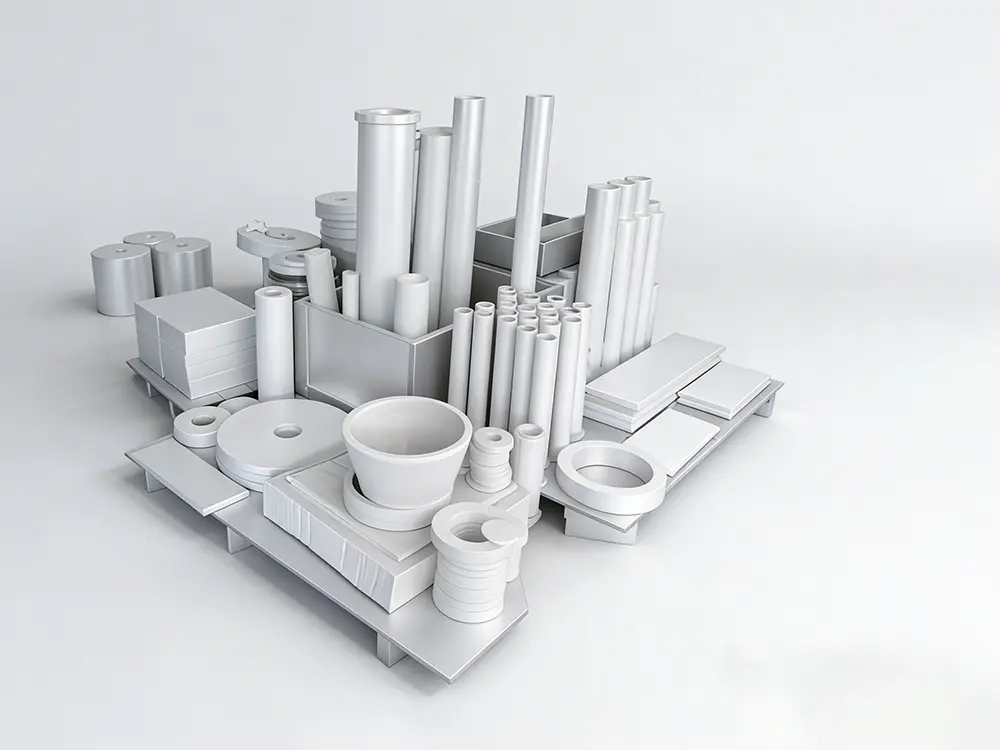
Benefiting from excellent product performance and stable quality, its products are extensively utilized in various high-end fields, such as food and medical industries, new energy vehicles, laser semiconductors, petrochemical engineering, powder metallurgy, national defense and military, as well as aerospace sectors.
Through robust quality assurance protocols and continuous R&D investment, Qiangguang solves severe material wear, high-heat degradation, and chemical oxidation challenges for global industrial clients.
Adhering to the core principle of "creating value for customers", Qiangguang provides customized and cost-efficient advanced ceramic solutions tailored to the specific demands of different customers. It is supported by high-quality after-sales services and a strict full-process tracking system, which effectively enhances cooperation efficiency and promotes continuous quality improvement.
At present, the company's products are sold well across the country and exported to Italy, the United Kingdom, Australia, Japan, Malaysia, Thailand, Hungary and other countries and regions. Committed to delivering high-quality products at reasonable prices, Qiangguang sincerely looks forward to establishing long-term and stable cooperative relations with global partners.
A strategic checklist for industrial sourcing directors, procurement managers, and design engineers.
Before issuing an RFQ, quantify maximum continuous temperature, thermal ramp rates, chemical concentration (pH range), mechanical load vectors, and allowable surface roughness. SSiC is optimal for chemical purity, while RBSiC offers cost efficiencies for complex shapes.
Ensure your supplier conducts ultrasonic flaw detection, C-scan imaging, liquid penetrant testing, and 3D CMM dimensional verification to eliminate micro-cracks or internal voids prior to international shipment.
Direct factory partners should provide quick-turn green machining, custom graphite tooling, and specialized shock-absorbing export wooden cases to prevent transit damage for fragile high-aspect-ratio ceramic tubes or rings.
Next-generation innovations reshaping the global market for high-temperature and extreme-duty industrial materials.
Selective Laser Sintering (SLS) and binder jetting technologies are enabling complex lattice structures, internal cooling channels, and lightweight optics made of Silicon Carbide that were previously unachievable through conventional cold pressing.
With global shifts toward hydrogen combustion, SiC components are critical for high-temperature water electrolysis cell plates and zero-emission micro-gas turbine heat exchangers resistant to steam oxidation at 1,300°C+.
Silicon Carbide's extremely low thermal expansion coefficient and high specific stiffness make it the premier choice for space telescope mirrors, satellite laser communications, and LIDAR sensors operating under severe space radiation.
Addressing key engineering, procurement, and material property inquiries from global buyers.
SSiC (Sintered Silicon Carbide) is sintered pressurelessly at ~2100°C without free metallic silicon, offering higher purity, maximum hardness (9.5 Mohs), and superior chemical corrosion resistance. RBSiC (Reaction-Bonded) contains 10-15% free silicon metal, which lowers production temperatures, prevents sintering shrinkage, and allows cost-effective production of large or highly complex parts.
SSiC is virtually inert to almost all hydrofluoric acid (HF), nitric acid (HNO3), sulfuric acid (H2SO4), and strong sodium hydroxide (NaOH) solutions up to 800°C. This makes it significantly more durable than metals, hastelloy alloys, or standard alumina ceramics in chemical handling pumps and seal rings.
Yes. Leading manufacturers like Yixing Qiangguang specialize in custom OEM/ODM production. Using CNC green machining prior to sintering followed by post-sinter precision diamond grinding, parts can be produced to exact CAD specifications with micron tolerances.
While alumina is cost-effective, SiC has higher hardness (9.5 Mohs vs 9.0 Mohs), double the flexural strength, and significantly higher thermal conductivity (120 W/m·K vs 30 W/m·K). This high thermal conductivity dissipates frictional heat quickly in seal faces, preventing thermal shock cracking.
Standard prototype samples typically take 2 to 3 weeks for tooling setup and initial green machining. Full volume wholesale manufacturing runs range between 4 and 6 weeks, depending on component size, sintering cycle, and surface finishing requirements.
China offers a completely integrated ceramic industrial supply chain—from raw mineral processing to precision diamond finishing. This integration minimizes supply bottlenecks, lowers raw material acquisition costs, and ensures rapid delivery to North American, European, and Asian markets.
Complete your technical ceramic procurement with our extended line of alumina, zirconia, silicon nitride, and titanate products.