
Explore engineered Zirconia and Alumina solutions developed for ultra-precise grinding, thermal stability, and extreme mechanical durability.
Founded in 2003, Yixing Qiangguang Ceramic Materials Co., Ltd. is a professional provider dedicated to the research and development (R&D), manufacturing, and application solutions of high-performance advanced ceramic materials. It is among the few enterprises in China that possess a complete industrial chain, covering key links from powder forming, sintering and precision machining to the provision of integrated application solutions.
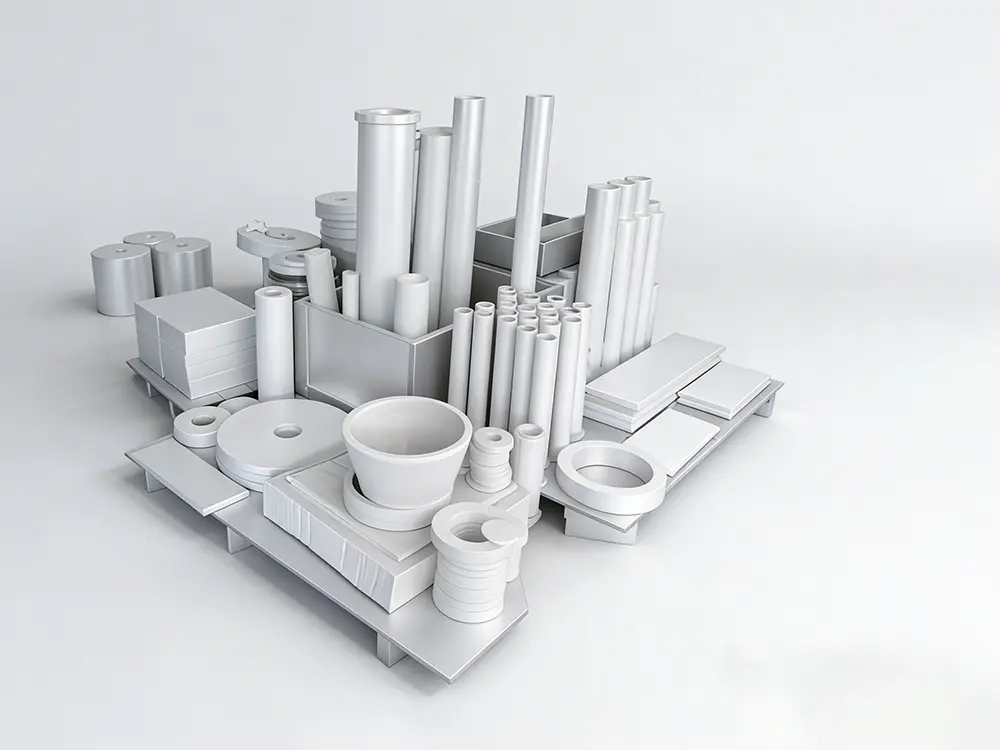
The company is also a rare domestic manufacturer engaged in the R&D, production, and supply of a comprehensive portfolio of ceramic materials. Its product range covers zirconia, yttria, alumina, magnesia, aluminum nitride, boron nitride, silicon nitride, silicon carbide, aluminum titanate and other key ceramic materials for industrial use.
A step-by-step technical breakdown of material formulation, green body consolidation, phase transformation sintering, and sub-micron diamond machining.
The manufacturing process begins with chemical coprecipitation or hydro-thermal synthesis of raw oxides (Al₂O₃, ZrO₂, SiC, AlN). To achieve exceptional phase stability and fracture toughness, stabilizing agents such as Yttrium Oxide (Y₂O₃), Magnesium Oxide (MgO), or Cerium Oxide (CeO₂) are homogeneously mixed at the molecular level. High-energy wet ball milling ensures particle size distribution down to the nanoscale ($d_{50} < 0.3\,\mu\text{m}$), eliminating agglomerates and establishing high sinterability.
Homogenized slurries undergo spray drying with organic binders to form free-flowing, spherical micro-granules. Forming technologies are selected based on component geometry: Cold Isostatic Pressing (CIP) at pressures exceeding 200 MPa yields ultra-uniform density distribution without directional density gradients; Ceramic Injection Molding (CIM) and Dry Pressing are deployed for complex geometric features and high-volume consistency.
Green compacts undergo debinding followed by high-temperature sintering in atmosphere-controlled computer kilns at temperatures ranging from 1450°C to 1800°C. During sintering, solid-state diffusion eliminates inter-particle porosity, resulting in theoretical densities reaching 99.5%+. For mission-critical applications requiring structural zero-porosity, Hot Isostatic Pressing (HIP) under argon atmosphere at 2000 bar further eliminates residual micro-voids.
Due to the extreme hardness of technical ceramics (Vickers Hardness $HV0.5 \ge 1300–1800$), post-sintering shape modifications require high-speed CNC diamond grinding, ultrasonic machining, and Chemical-Mechanical Polishing (CMP). Tolerances are routinely held to within $\pm 0.001\text{ mm}$, with surface roughness achievable down to $Ra < 0.01\,\mu\text{m}$ for mechanical seals and optical reflector surfaces.
Every production lot undergoes rigorous material characterization. Analytical testing includes X-Ray Diffraction (XRD) for phase composition analysis, Scanning Electron Microscopy (SEM) for microstructural grain size verification, laser ultrasonic testing for internal micro-crack detection, and coordinate measuring machines (CMM) for geometric accuracy compliance.
Comparative physical, mechanical, and thermal parameters across core ceramic formulations.
| Material Type | Density (g/cm³) | Flexural Strength (MPa) | Fracture Toughness (MPa·m¹/²) | Thermal Conductivity (W/m·K) | Max Operating Temp (°C) |
|---|---|---|---|---|---|
| Yttria-Stabilized Zirconia (YSZ) | 6.05 | 1000 - 1200 | 9.0 - 12.0 | 2.5 - 3.0 | 1150 |
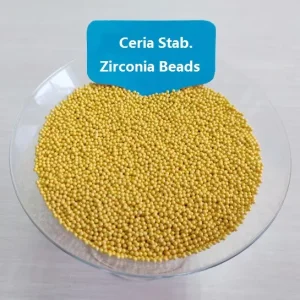
| Ceria-Stabilized Zirconia (Ce-TZP) | 6.20 | 700 - 900 | 13.0 - 18.0 | 2.0 | 1050 |
| High-Purity Alumina (99.8% Al₂O₃) | 3.92 | 380 - 450 | 4.0 - 4.5 | 30.0 | 1650 |
| Silicon Carbide (SSiC) | 3.15 | 400 - 550 | 3.5 - 4.0 | 120.0 - 140.0 | 1600 |
| Aluminum Nitride (AlN) | 3.30 | 320 - 380 | 3.0 | 170.0 - 200.0 | 1000 (Inert) |
| Aluminium Titanate (Al₂TiO₅) | 3.35 - 3.60 | 30 - 60 | 1.5 - 2.5 | 1.5 - 2.0 | 1400 |
Why leading global original equipment manufacturers (OEMs) choose Chinese technical ceramic manufacturers for long-term production resilience.
China commands over 70% of global rare earth processing and high-purity oxide synthesis capacity. Direct proximity to primary mineral extraction and refining hubs minimizes raw powder procurement lead times and shields buyers from upstream market price volatility.
Leading suppliers like Yixing Qiangguang control the complete chain—from powder formulation and green-state machining to high-temperature vacuum sintering and sub-micron diamond polishing—guaranteeing zero middleman markup and unified quality accountability.
With localized tooling fabrication and 5-axis CNC machining, engineering prototypes can be realized in days rather than months. Production facilities scale effortlessly from low-volume specialized components to million-unit automated production runs.
By leveraging energy-efficient continuous tunnel kilns, high automation rates, and optimized yield management, Chinese ceramic manufacturers offer 30% to 50% cost advantages over Western peers without compromising strict international technical standards.
Engineered to solve severe wear, high temperature, chemical attack, and electrical insulation challenges.
High-purity Alumina and Silicon Carbide ceramics serve as wafer end-effectors, plasma-resistant chamber rings, and laser diode heat sinks due to zero outgassing, high plasma etch resistance, and exceptional dielectric performance.
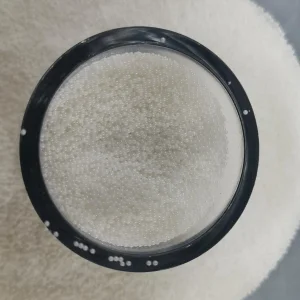
Zirconia beads enable nano-scale wet grinding of lithium iron phosphate (LFP) cathode materials down to <100nm. Silicon Nitride ceramic balls provide electrical isolation and wear longevity in high-RPM electric motor bearings.
Aluminium Titanate and Boron Nitride components function in extreme thermal shock environments, including rocket engine nozzle liners, turbine thermal barrier coatings, and lightweight ballistic armor plating.
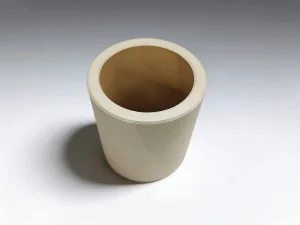
Zirconia and SiC valve balls, mechanical seal faces, and mud pump liners exhibit total resistance to strong acid, alkaline corrosion, and intense solid slurry erosion, vastly extending mean time between failures (MTBF).
Biocompatible Yttria-stabilized Zirconia delivers unmatched wear resistance for hip joint prosthetics, dental crowns, and non-contaminating dosing plungers in pharmaceutical and food packaging lines.
Eliminating cross-border technical friction through standardized quality engineering and full international certification compliance.
Navigating international supply chains requires uncompromised transparency and compliance. Technical ceramic manufacturing at Yixing Qiangguang is governed by integrated management systems certified to ISO9001 (Quality Management) and ISO14001 (Environmental Management).
All raw powders and finished ceramic components conform strictly to European Union RoHS Directive 2011/65/EU and REACH Regulation (EC) No 1907/2006, ensuring freedom from hazardous heavy metals. For medical devices and food contact equipment, components undergo rigorous leaching tests to meet FDA 21 CFR compliance.
Localized technical support packages include full material traceabilities, Material Test Reports (MTR) per EN 10204 3.1, custom OEM/ODM engineering drawing reviews (GD&T per ASME Y14.5), and dedicated multi-lingual engineering teams for seamless joint-development programs.
Next-generation innovations reshaping the global advanced ceramics landscape over the coming decade.
Stereolithography (SLA) and Digital Light Processing (DLP) ceramic 3D printing technologies are breaking traditional tooling limits, enabling intricate internal cooling channels and complex lattice structures for aerospace heat exchangers without diamond tooling limitations.
Integration of carbon nanotubes, graphene, and phase-transformation microstructures into Zirconia-Toughened Alumina (ZTA) and Silicon Nitride matrix systems is raising fracture toughness values beyond $15\,\text{MPa}\cdot\text{m}^{1/2}$, expanding ceramic usage into extreme impact environments.
Adoption of Spark Plasma Sintering (SPS) and Flash Sintering techniques drastically reduces thermal processing cycles from tens of hours to minutes. This suppresses grain growth to preserve nanostructures while lowering factory carbon footprints by up to 60%.
Expert technical insights answering key procurement and material selection inquiries.
Discover premium-grade engineered materials designed for industrial heat resistance, anti-corrosion, and dispersion systems.
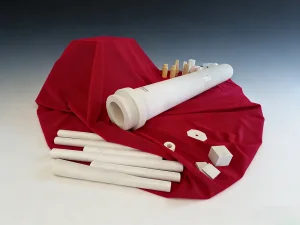
Adhering to our core principle of "Creating Value for Customers", Yixing Qiangguang provides customized, high-precision, and cost-efficient ceramic material solutions tailored to your operational environment. Supported by robust global presence across Italy, the UK, Australia, Japan, Malaysia, Thailand, Hungary, and beyond.