Explore our premium factory-direct advanced ceramics optimized for extreme mechanical stress and high-voltage power electronics.
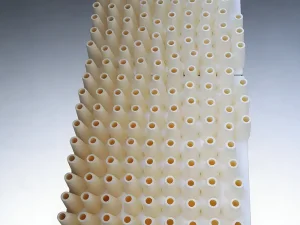
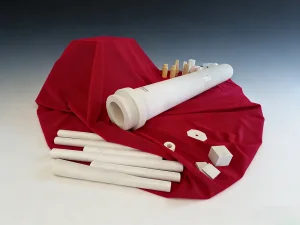
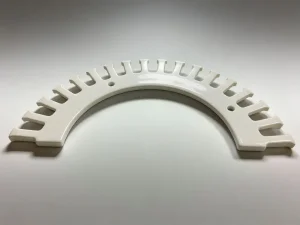
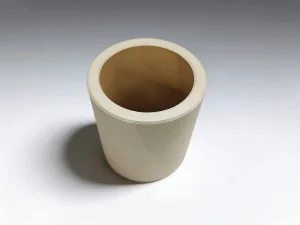
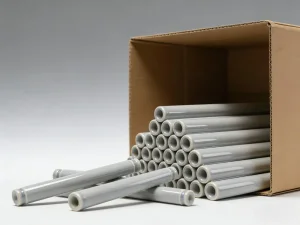
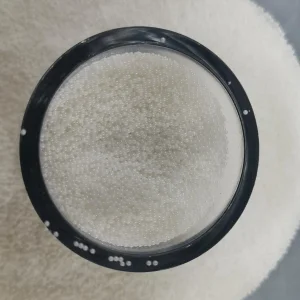
The global shift toward high-voltage, high-frequency wide-bandgap (WBG) semiconductor chips, specifically Silicon Carbide (SiC) and Gallium Nitride (GaN), has exposed the physical limitations of conventional alumina (Al2O3) and aluminum nitride (AlN) substrates.
Silicon Nitride (Si3N4) substrates exhibit thermal expansion coefficients (CTE: 3.0 x 10⁻⁶/K) closely matched with SiC chips. This reduces thermo-mechanical fatigue, allowing 800V electric vehicle traction inverters to endure over 100,000 deep thermal cycles without solder layer delamination or copper cracking.
Because Si3N4 possesses exceptional fracture toughness (>7.0 MPa·m¹/²), it permits the deposition of thick copper layers (up to 0.8mm or 1.0mm) via Active Metal Brazing (AMB). This creates ultra-low resistance electrical paths while maintaining structural integrity under rapid thermal shocks.
From high-voltage DC (HVDC) power transmission converters to aerospace radar transmit/receive modules, Si3N4 substrates withstand severe operational stresses, humidity, and high-frequency noise while preserving electrical insulation efficiency.
Quantitative analysis highlighting why Silicon Nitride (Si3N4) represents the gold standard for high-reliability semiconductor packaging.
| Material Property | Silicon Nitride (Si3N4) | Aluminum Nitride (AlN) | Alumina (Al2O3 - 96%) | Zirconia Toughened Alumina (ZTA) |
|---|---|---|---|---|
| Thermal Conductivity (W/m·K) | 85 - 120 | 170 - 200 | 24 - 30 | 30 - 35 |
| Flexural Strength (MPa) | 850 - 1000 | 300 - 400 | 350 - 450 | 600 - 700 |
| Fracture Toughness (MPa·m¹/²) | 6.5 - 7.5 | 2.5 - 3.0 | 3.5 - 4.0 | 4.5 - 5.0 |
| Coefficient of Thermal Expansion (10⁻⁶/K) | 3.0 - 3.2 | 4.5 - 4.8 | 6.8 - 7.2 | 7.5 - 8.0 |
| Dielectric Strength (kV/mm) | > 15 | > 15 | > 12 | > 14 |
| Thermal Shock Resistance (ΔT °C) | > 800 °C | ~ 200 °C | ~ 200 °C | ~ 300 °C |
| AMB Thick Copper Bonding Compatibility | Optimal (> 0.8mm Cu) | Moderate (Prone to cracking) | Poor (Limited thickness) | Moderate |
Achieving optimal thermal conductivity alongside mechanical toughness requires ultra-precise control over grain boundaries and sintering additives.
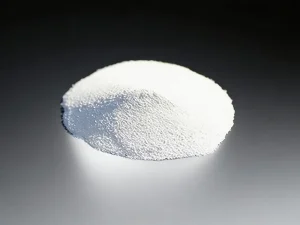
We synthesize high-purity silicon nitride raw powder with an α-phase content exceeding 93%. Low oxygen impurity levels ensure minimal phonon scattering within the crystalline lattice.
Utilizing high-precision doctor blade tape casting, we produce uniform green sheets ranging from 0.25mm to 1.0mm in thickness with tight dimensional tolerance and flawless surface smoothness.
By employing high-pressure nitrogen atmospheres during sintering (1750°C - 1850°C), α-Si3N4 transforms into interlocking β-Si3N4 rod-like grains, giving the ceramic its legendary fracture toughness.
Double-sided precision diamond polishing guarantees surface roughness Ra < 0.2 µm. High-speed UV laser scribing allows custom breakout geometries with zero micro-cracking along edges.
Founded in 2003, Yixing Qiangguang Ceramic Materials Co., Ltd. is a professional provider dedicated to the research and development (R&D), manufacturing, and application solutions of high-performance advanced ceramic materials. It is among the few enterprises in China that possess a complete industrial chain, covering key links from powder forming, sintering and precision machining to the provision of integrated application solutions.
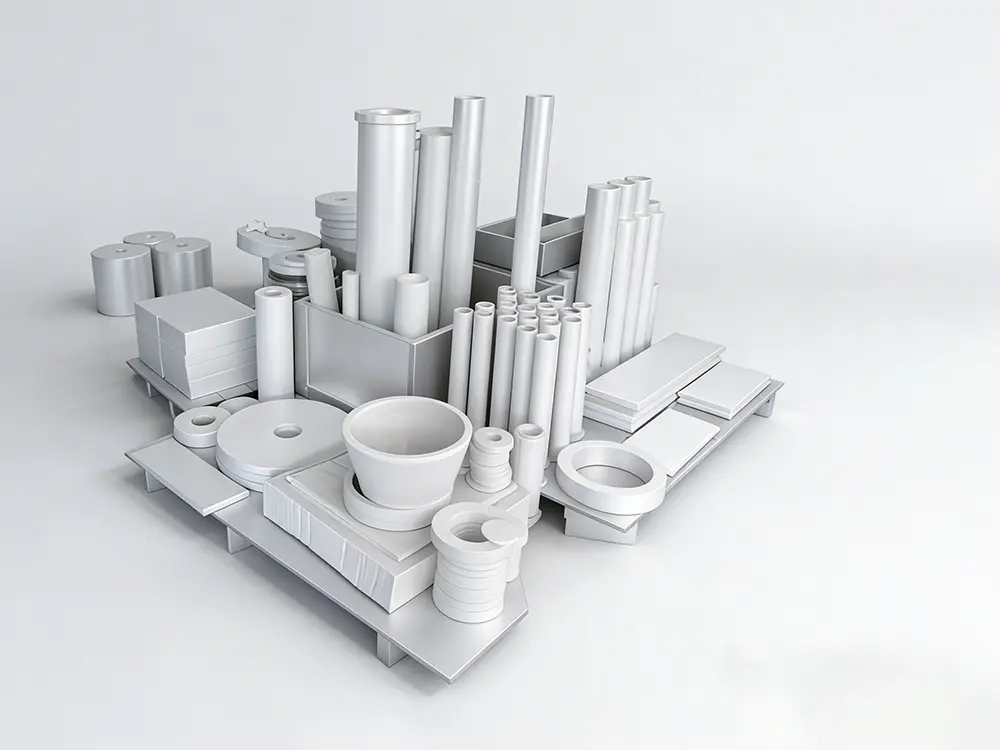
The company is also a rare domestic manufacturer engaged in the R&D, production, and supply of a comprehensive portfolio of ceramic materials. Its product range covers zirconia, yttria, alumina, magnesia, aluminum nitride, boron nitride, silicon nitride, silicon carbide, aluminum titanate and other key ceramic materials for industrial use.
Benefiting from excellent product performance and stable quality, its products are extensively utilized in various high-end fields, such as food and medical industries, new energy vehicles, laser semiconductors, petrochemical engineering, powder metallurgy, national defense and military, as well as aerospace sectors.
Our Principle: Adhering to the core principle of "creating value for customers", Qiangguang provides customized and cost-efficient advanced ceramic solutions tailored to the specific demands of different customers. It is supported by high-quality after-sales services and a strict full-process tracking system, which effectively enhances cooperation efficiency and promotes continuous quality improvement.
Global Presence: At present, the company's products are sold well across the country and exported to Italy, the United Kingdom, Australia, Japan, Malaysia, Thailand, Hungary and other countries and regions. Committed to delivering high-quality products at reasonable prices, Qiangguang sincerely looks forward to establishing long-term and stable cooperative relations with global partners.
Seamless international logistics combined with stringent quality management standards guarantees uninterrupted supply for Tier-1 automotive and semiconductor manufacturers.
All silicon nitride manufacturing lines strictly operate under ISO 9001:2015 and IATF 16949 automotive quality management system certifications. Complete lot traceability ensures zero-defect delivery.
Products fully comply with EU REACH, RoHS 3.0, and Conflict Mineral regulations. Heavy-metal free processing environments protect both human health and ecological sustainability.
With localized engineering hubs and distribution channels in Europe, North America, and Southeast Asia, we offer rapid DFM (Design for Manufacturability) consulting and fast turn-around prototyping.
Continuous investment in R&D ensures our substrate materials push the boundaries of thermal dissipation and physical endurance.
Developing ultra-pure rare-earth sinter additives (Y2O3-MgO-Yb2O3 systems) to eliminate intergranular glass phases, raising commercial thermal conductivity targets above 130 W/m·K.
Innovating sub-0.3mm ultra-thin substrates designed specifically for double-sided cooling (DSC) power modules, minimizing thermal resistance without compromising mechanical yield.
Integrating artificial intelligence algorithm models into furnace thermal profiles to achieve 99.9% theoretical density and uniform grain orientation across multi-tier sintering loads.
Direct answers to critical technical questions asked by power electronics design engineers and procurement directors.
While Aluminum Nitride (AlN) has higher initial thermal conductivity (170-200 W/m·K), its low fracture toughness (~3.0 MPa·m¹/²) causes substrate cracking under thermo-mechanical stress. Silicon Nitride (Si3N4) possesses fracture toughness of 7.0 MPa·m¹/² and flexural strength >850 MPa, allowing it to withstand thick copper bonding (AMB process) and aggressive thermal cycling (-55°C to 175°C) in electric vehicle inverters without mechanical failure.
Our silicon nitride substrates are fully optimized for Active Metal Brazing (AMB) using Ag-Cu-Ti filler alloys, as well as Direct Bonded Copper (DBC) and Thin-Film Metallization (Ti/Ni/Au or Cu sputtering). AMB-Si3N4 is the industry standard for high-power density switching modules.
Standard substrate thicknesses include 0.25mm, 0.32mm, 0.50mm, and 0.635mm. Master card sizes are typically 138 x 190 mm or 140 x 190 mm. Custom dimensions, pre-scribed breakouts, and ground surfaces are available upon request.
Si3N4 features a CTE of approximately 3.0 to 3.2 x 10⁻⁶/K between 25°C and 400°C. This is remarkably close to Silicon Carbide (SiC: ~3.7 x 10⁻⁶/K) and Silicon (Si: ~2.6 x 10⁻⁶/K), dramatically minimizing shear stress on solder joints during operation.
We employ Gas Pressure Sintering (GPS) under a controlled nitrogen atmosphere at 10 to 100 bar pressure. This process prevents silicon nitride dissociation and encourages dense β-phase grain needle growth for maximum toughness.
Yes, our high-precision CNC laser micro-machining centers support both rapid custom prototyping and high-volume laser scribing with tight tolerances (±0.05mm).
Explore our complete catalog of industrial grade ceramic materials engineered for severe mechanical, chemical, and high-temperature environments.